Communication is key. That’s as true for efficient warehouses as it is for relationships. If the different sectors of your warehouse aren’t talking to each other, you are going to run into problems.
Warehouse orchestration is about seeing your warehouse as a whole unit. It integrates and coordinates the various technologies, processes, and resources within your warehouse into one cohesive unit. This goes beyond automation. It goes beyond data collection. Orchestrating your warehouse allows you to see and understand how your warehouse functions, leverage your technology and labour force, and helps you make clearer and better decisions about how to improve or adjust operations.
When your warehouse is properly orchestrated, everything functions more optimally. From inventory management to workflow optimization and using automation to effectively supplement the work done by your employees, warehouse orchestration helps everything run as a cohesive unit.
WHY DOES WAREHOUSE ORCHESTRATION MATTER?
Instead of segmenting your warehouse into different sectors, warehouse orchestration helps you view it as an integrated whole. It shows how inventory and storage solutions affect one another. Or how automation and labour are interconnected. By seeing your warehouse as a whole, and creating systems for the different components to communicate, you experience:
- Enhanced efficiency and productivity
- Improved accuracy and quality control
- Flexibility and adaptability
- Cost accuracy and savings
- Enhanced decision making
The technology we have available to us today allows us to orchestrate our warehouses like never before. There’s more data available, and better tools for distilling and analysing it. Automation allows us to be more efficient with our systems. If you’re not taking advantage of the technology available to better orchestrate your warehouse, you risk falling behind.
HOW DO AUTOMATION-COMPATIBLE CRATES HELP WITH WAREHOUSE ORCHESTRATION?
Integrating automation is a great way to improve your warehouses’ systems, performance, and enhance overall orchestration. It can speed up processes, provide greater data accuracy, and make your warehouse more adaptable. But if your crates aren’t compatible with the automation technology, you’ve spent a lot of money for sub-optimal performance.
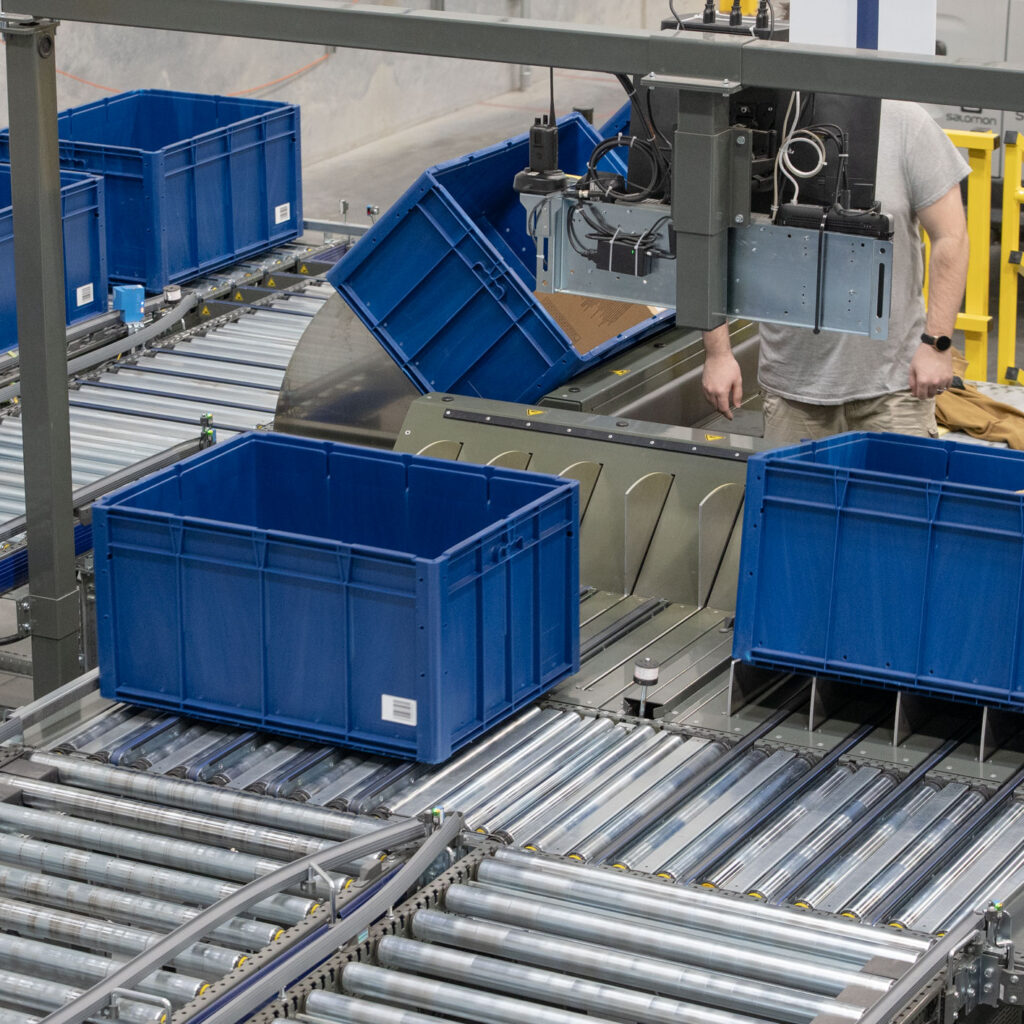
Traditional cardboard crates simply don’t stack up. RollerPlast crates help with automation by offering:
- Standard sizing–whether industry standard, or custom to your needs
- Improved strength and durability
- Stack geometry that improves transport and storage
- RFID compatibility for real-time inventory tracking
- Proper weight distribution to match AMR payload and lift tolerances (e.g., ABB’s P603 model handles up to 1,500 kg with stability sensors)
Think of it like building a house. If you build it with termite-ridden boards and crumbly brick, it’s only a matter of time before it falls apart. When you are orchestrating your warehouse to optimize performance, you need to implement these new strategies with quality crates to set a good foundation.
HOW OPTIMIZED CRATES ENHANCE WAREHOUSE PERFORMANCE
Have you ever heard the phrase, “the sum is only as great as its parts?” It perfectly encapsulates why your crates matter. When looking at maximizing your warehouse performance, you need to look at every component, not just the larger systems.
Your crates are one of the few components of your warehouse that interact with and thereby affect each and every system. Receiving, storage, shipping, employee well-being, and automated systems—all of these are impacted by your crate selection.
Every orchestration strategy eventually becomes physical. What looks good on paper needs to perform when made real. Data, workflows, and automation rely on products moving consistently through the building. Your crates are what connect these systems; choose wisely.
CAN IMPROPER CRATES AFFECT WAREHOUSE ORCHESTRATION?
For warehouses to be properly orchestrated and function optimally, all of the parts must work together cohesively. If one element lags behind, it can negatively impact the rest of the operation. Which means, yes, even your crates matter. Cardboard or other suboptimal crates can cause issues like:
- AMRs stopping because tote dimensions drift
- Conveyor sensors misreading inconsistent sidewalls
- Stack instability causing manual rework
- Variable footprints reducing AS/RS density
- Damaged boxes changing pick consistency
- Containers jamming systems
- Operators manually adjusting unstable stacks
Every little issue can add up to create bottlenecks, stack instability, storage issues, and unplanned manual interventions that cost time and money. If you want a warehouse that runs smoothly, you have to consider every factor and work to optimize it.
HOW DOES CRATE SELECTION AFFECT WAREHOUSE ORCHESTRATION?
Warehouse crates are involved in every system within your warehouse, from shipping and receiving to storage and automation. Warehouse orchestration is about ensuring every aspect of your warehouse not only functions optimally, but functions cohesively as well. If you want warehouse orchestration, you need crates, the things that affect every area of your warehouse, to be optimized.
FAQs
WHAT IS WAREHOUSE ORCHESTRATION?
Warehouse orchestration is the process of integrating and coordinating the technologies, workflows, labour, and resources within your warehouse so they function as one cohesive system. Rather than treating each department or process separately, orchestration helps operations work together more efficiently, improving productivity, accuracy, flexibility, and decision-making.
WHY DO CRATES MATTER IN WAREHOUSE ORCHESTRATION?
Crates are one of the few components that interact with every part of the warehouse. Receiving, storage, shipping, employee workflows, and automation systems are all affected by container performance. Because crates move through every stage of the operation, poor crate selection can create friction across the entire system.
HOW DO AUTOMATION-COMPATIBLE CRATES IMPROVE WAREHOUSE ORCHESTRATION?
Automation-compatible crates help systems run more consistently and efficiently. Features such as standardized sizing, stable stack geometry, RFID compatibility, and proper weight distribution allow crates to move cleanly through conveyors, AMRs, and AS/RS systems while supporting accurate inventory tracking and reliable handling.
CAN POOR CRATE SELECTION CREATE OPERATIONAL INEFFICIENCIES?
Yes. Suboptimal crates can create a range of operational issues, including unstable stacks, conveyor jams, inconsistent picking, reduced storage density, and repeated manual interventions. Small inconsistencies can quickly add up, creating bottlenecks that slow down workflows and increase costs across the warehouse.
WHY IS CONSITENCY IMPORTANT IN WAREHOUSE CONTAINERS?
Warehouse orchestration depends on systems functioning predictably together. Consistent crate dimensions, strength, and stackability help products move reliably through storage, automation, and transport systems. When containers behave differently from one cycle to the next, operational flow becomes less stable and less efficient.